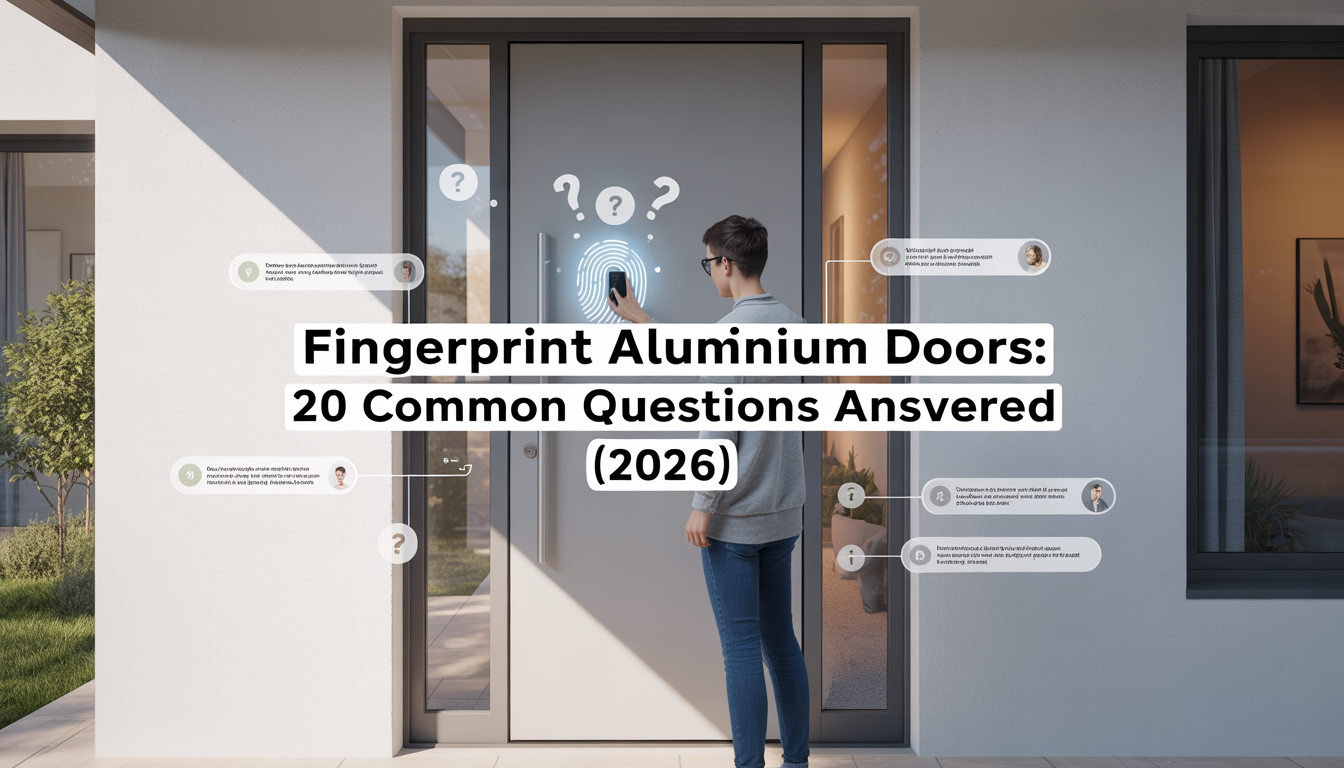


How Secure Are Biometric Aluminium Doors? Risks, Myths & Smart Lock Comparison
The honest answer is that a well engineered biometric aluminium door is significantly more secure than a traditional locked door, more secure than most smart locks bolted onto existing doors, and not vulnerable to the attack methods most people worry about. But the words “well engineered” are doing a lot of work in that sentence. This article unpacks why.
If you’re new to this, start with the fingerprint aluminium door beginner guide
How fingerprint security actually works
For full context, see the fingerprint aluminium door buying guide
When you enrol a finger, the sensor doesn’t store a picture of your fingerprint. It runs the image through an algorithm that extracts dozens of unique reference points the way ridges split, end, or curve and saves them as a mathematical template, typically a few hundred bytes of encrypted data.
That template is one way. You cannot reconstruct a fingerprint from it. You can only compare a new scan against it.
In a properly designed door, this template lives in a secure element on the door’s controller, the same kind of tamper resistant chip used in payment cards. It never travels to the cloud. Even the manufacturer cannot extract it.
When a finger is presented, the sensor captures, extracts, encrypts and compares all on device and either sends an “open” command to the lock or rejects the attempt. The whole cycle takes around half a second.

The security advantages over a traditional door
A standard UK front door fails in predictable ways. The euro cylinder gets snapped, picked or bumped. Keys get copied at any kiosk. Spare keys get hidden under plant pots. Tradespeople get keys handed over and never returned.
A fingerprint aluminium door eliminates most of this in one move:
- No external cylinder to attack on premium models
- No physical key circulating in the world
- Multi point motorised locking that engages automatically every time the door closes
- Audit log showing every entry attempt, successful or not
- Lockdown after failed attempts usually a 30 second to 5 minute freeze after several wrong scans
The aluminium frame and reinforced panel also resist the brute force methods used on weaker doors kicking, jemmying, drilling far better than a hollow composite or timber door.
The risks that are real
It is fair to ask what could go wrong. There are three risks worth taking seriously.
Power failure. The lock is electronic. Quality systems mitigate this with battery backup that holds the door operational for several days, plus a concealed mechanical override. But “no power, no entry” is a real failure mode if the system is poorly designed.
Sensor failure or wear. Fingerprint sensors are mechanical components and can degrade over years of use. Reputable manufacturers rate sensors for hundreds of thousands of cycles and offer service replacement.
Network compromise. If the door is internet connected and the manufacturer’s cloud is breached, an attacker could potentially issue remote unlock commands. This is mitigated by end to end encryption, two factor authentication on the app, and critically keeping biometric data off the cloud entirely.
The risks that are mostly myths
“Someone can lift my fingerprint from a glass and unlock the door.” In theory, with a high resolution photograph, specialist materials and undisturbed access to the door, a flat fake could be produced. In practice, modern capacitive sensors with liveness detection look for the electrical signature of living tissue, not just a pattern. This attack has never been a meaningful real world threat against quality residential biometric doors.
“Hackers can intercept my fingerprint over Wi Fi.” Your fingerprint is never transmitted over Wi Fi. The template stays on the door. Only commands (“lock”, “unlock”, “enrol new user”) travel between the app and the door, and they are encrypted.
“If I cut my finger, the door won’t open.” Sensors compare multiple reference points and tolerate minor changes. A small cut or plaster on one finger isn’t a problem and you almost always have multiple fingers enrolled.
“Police / criminals / hackers can override the door from outside.” No. There is no master backdoor in a properly designed system. Even the manufacturer cannot remotely unlock your door without your authorised account credentials.
How biometric aluminium doors compare to smart locks
Smart locks (Yale, August, Nuki and similar) are popular because they are cheap and easy to retrofit. They are not the same product.
A smart lock is a battery powered electronic mechanism that replaces the inside of an existing euro cylinder, while leaving the outside cylinder intact. This means:
- The door itself is unchanged same weak frame, same single point latch
- The external cylinder is still vulnerable to snapping
- The whole assembly runs on AA batteries that need replacing
- Connectivity is usually Bluetooth, with Wi Fi via an extra hub
A fingerprint aluminium door is an integrated system. The door, the frame, the locking mechanism, the sensor and the connectivity are designed together. There is no weak link to attack because the points smart locks leave exposed simply do not exist.
A smart lock is a sensible upgrade to a sensible door. A biometric aluminium door is a different category of product.
See detailed specs here: compare fingerprint aluminium door specifications
What “good” looks like in 2026
If you are evaluating a biometric aluminium door on security grounds, the spec sheet should include:
Learn more: PAS 24 and Secured by Design certification explained
- PAS 24 certification (UK enhanced security standard)
- Secured by Design accreditation where possible
- Capacitive fingerprint sensor with liveness detection
- Local, encrypted biometric storage on a secure element
- Motorised multi point locking with auto engagement
- No external cylinder, or a 3 star anti snap cylinder if one is fitted
- AES 256 encryption on app communications
- Two factor authentication on the management app
- UK based support and security update commitments
For exact specs or a tailored option, request a door specification or sample
FAQ
Can a fingerprint door be hacked?
The sensor and lock cannot be hacked in any meaningful way. The connected app is the realistic attack surface, which is why two factor authentication and a reputable manufacturer matter.
Is biometric data sent to the cloud?
It should not be. In any well designed door, fingerprint templates stay on the door itself, encrypted on a secure chip.
What happens after too many failed attempts?
The door enters lockdown for a set period typically 30 seconds to 5 minutes and the owner receives a push notification.
Are biometric doors GDPR compliant?
Yes, when properly implemented. Because templates are stored locally and never transmitted, the manufacturer doesn’t process your biometric data.